DS93X™ Heat Treatment: The Official Hardening Guide
Master the process with your definitive DS93X™ heat treatment guide, featuring the official factory parameters for austenitizing, quenching, and tempering. Follow this precise metallurgical resource to safely unlock ultimate edge retention, corrosion resistance, and a flawless finish.
Quick parameters & key takeaways for DS93X™ Heat Treatment
- Primary Target: DS93X™ heat treatment & hardening parameters.
- Optimal Austenitizing Temperature: 1080°C (1975°F) with a strict holding time of 15 minutes.
- Critical Quenching Window: Rapid cooling to 50°C (122°F) within 2 minutes using oil or heavy aluminum plates.
- Standard Tempering Recipe: Between 150-450°C (300-842°F) for 2 hours (1 cycle) to remove internal stresses.
- Target Hardness Yield: Achieves an optimal 63 HRC for RWL34™ and 60 HRC for PMC27™ layers.
- Cryogenic Treatment (Optional): Sub-zero cooling below -100°C for 2 hours (or Liquid Nitrogen for 30 minutes) before tempering completes the martensite transformation for maximized durability.
What makes DS93X™ so special?
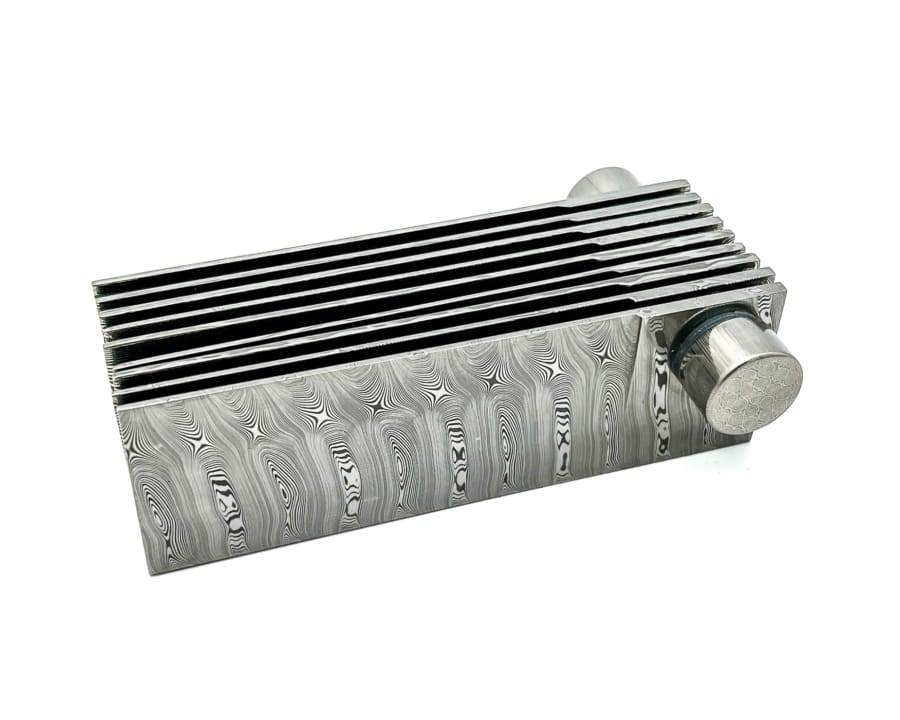
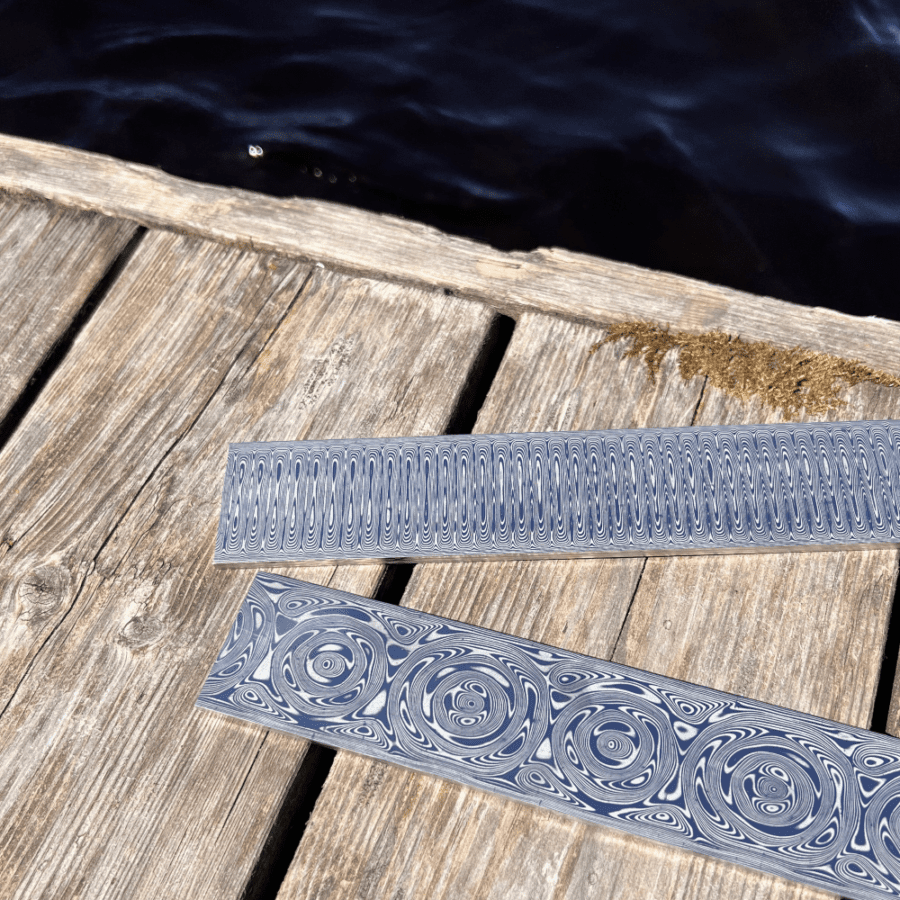
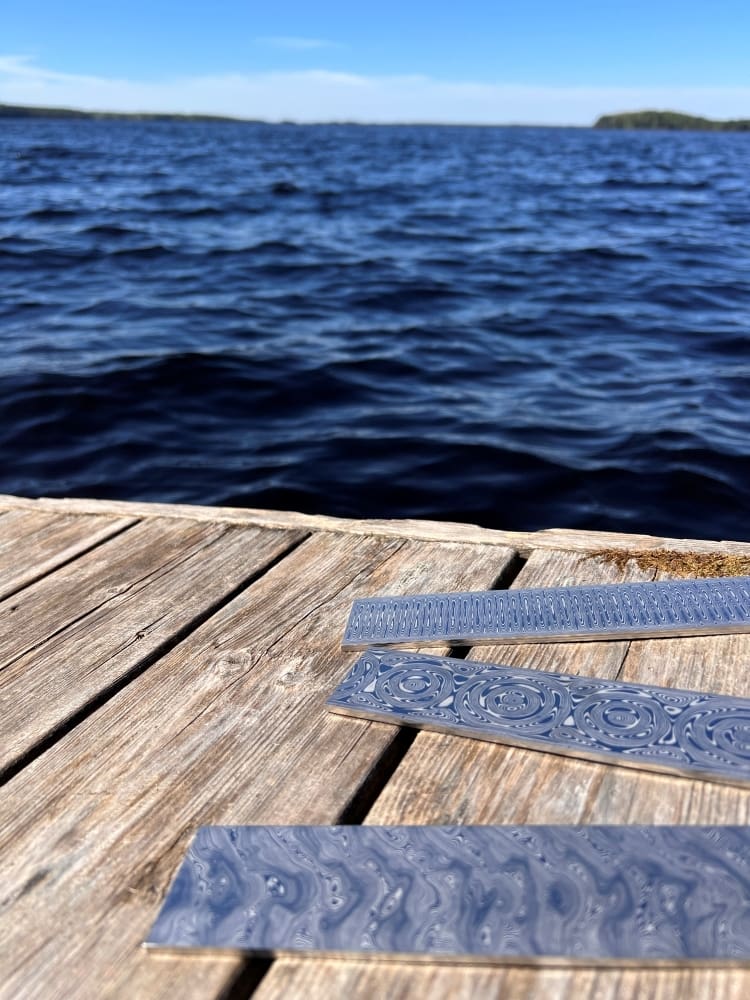
Damasteel’s stainless Damascus steel is a powder-based blend of RWL34™ and PMC27™, both martensitic alloys with at least 13% chromium. It combines excellent corrosion resistance, strength, and edge retention, offering great cutting performance while remaining easy to maintain, and is ideal for knives and other edge tools.
- Best overall performing stainless Damascus patterned steel
- Excellent edge retention and corrosion resistance
- Highest cleanliness with no inclusions
- Incomparable toughness and strength
- Patented Powder Metallurgy product
- Solid Steel Technology™ resulting in a homogenous product
- Top quality and easy to work with ensures a perfect result
- Available in all Damasteel® patterns.
Step-by-Step DS93X™ heat treatment guide
Phase 1: Austenitizing & Soaking
Target: 1080 °C (1975 °F) | Soaking: 15 min.
Place your clean workpiece into a furnace. Ramp up the temperature to exactly 1080 °C (1975 °F). Once the steel reaches this target temperature throughout its core, hold it for a strict soaking time of 15 minutes. This precise window dissolves the essential carbides into the solid solution without triggering unwanted grain growth.
Phase 2: Quenching
Target: Down to 50 °C (122 °F) within 2 minutes
Remove the piece from the furnace and ensure it reaches 50 °C (122 °F) within two minutes. You can use plate quenching by clamping the piece tightly between thick aluminum blocks with compressed air, or immersing it directly into oil. Cooling in the air also works. Apply light pressure to the piece during air cooling to prevent bending from uneven cooling. Slow cooling will result in retained austenite, severely softening your final edge.
Phase 3: Tempering & Optional Cryo
Target: 175 °C (345 °F) for 2 hours
To relieve internal stresses and optimize edge retention for knife applications, temper the steel at 175 °C (345 °F) for a duration of 2 hours (1 cycle).
Pro-Tip (Cryogenic Treatment): While not strictly required, deep freezing can be used to complete the martensite transformation. For maximum hardness, submerge the workpiece below -100 °C (-148 °F) for 2 hours, or in Liquid Nitrogen at -198 °C (-324 °F) for 30 minutes immediately after quenching and before starting the tempering cycle.
⚠️ Metallurgical Warning: Always perform the tempering cycle immediately after the steel has cooled down from the quench. Leaving a fully hardened, untempered blade resting at room temperature creates extreme internal structural tension, which can cause the steel to develop micro-cracks or warp unpredictably.
Official heat treatment parameters for DS93X™
This structured reference guide contains the verified factory specifications for hardening Damasteel® alloys. For standard knife blade applications, follow the specific parameters outlined in the first row.
| Application | Austenitizing Temp (A) | Holding Time | Quench Method | Tempering Temp (T) Time | Tempering Time | Expected Hardness (RWL34™ / PMC27™) |
Knife Blades (Standard) | 1080°C / 1975°F | 15 minutes | Oil or Aluminium Blocks (<2 min to 50°C) | 175°C / 345°F | 2 hours | 63 HRC / 60 HRC |
| General / Structural | 1080°C / 1975°F | 15 minutes | Oil or Plates | 150°C – 450°C | 2 hours | Variable (Maintains corrosion resistance) |
*Note: For specialized industrial or design applications, the tempering temperature can be adjusted within the 150°C to 450°C (300 °F – 842 °F) window to tailor the toughness-to-hardness ratio without sacrificing the steel’s premium corrosion resistance. All martensitic material supplied from Damasteel is soft annealed, hardness < 25 HRC

Application specific heat treatment
For Forging & Hot Work Applications
For forging and hot work applications, forge or roll stainless Damascus-patterned steel at temperatures between 1050–1160°C (1920–2120°F). Compared with low-alloy steels, martensitic stainless steels exhibit significantly higher deformation resistance—often nearly double—so hand forging is practical only for smaller sections. Because the material begins to melt at approximately 1220°C (2230°F), maintain careful temperature control to prevent overheating. Use electric or gas-fired furnaces, and avoid prolonged soaking above 850°C (1560°F) to minimize decarburization and scale formation.
After hot working, cool the material slowly because it undergoes a martensitic phase transformation at around 200°C (390°F), which can increase the risk of cracking. Cool the material in vermiculite or other insulating materials. To further reduce the risk of cracking, do not grind, cut, or machine the material until after annealing. Damasteel supplies all material in the annealed condition.
Welding
Martensitic stainless steels can be susceptible to cracking during cooling after welding or other hot processes because they undergo martensitic transformation at approximately 200°C (390°F). Proper preheating or post-weld heat treatment can minimize this risk. Stainless Damascus-patterned steel can be welded using the full range of conventional welding methods when operators follow appropriate procedures.
Cold Working
Martensitic stainless steel is less readily cold worked than conventional austenitic stainless steel grades, but it can be formed and fabricated using a wide range of cold working processes. The material offers good ductility, and any cold working operation will increase both its strength and hardness, making it well-suited for applications requiring enhanced mechanical performance.
Machining
Martensitic stainless steels generally machine more easily than many other stainless steel grades. In the soft-annealed condition, machinists can use high-speed steel (HSS) or carbide tooling to drill, tap, ream, mill, and turn stainless Damascus-patterned steel. Typical machining characteristics include material buildup on the cutting edge and tough, stringy chip formation. In the hardened and tempered condition (56–61 HRC), use ceramic or CBN inserts for milling and turning to achieve optimal machining performance and maximize tool life.
Grinding and Polishing
Use standard grinding and polishing techniques when working with martensitic stainless steel. For optimal grinding performance, use a silicon carbide grinding wheel with a 46-grit, soft, open-structure, ceramic-bonded specification (C46J6V). Typical grinding parameters include a wheel speed of approximately 35 m/s and a feed rate of 0.01–0.05 mm per stroke. For best results, maintain the workpiece speed at roughly 1/60 of the grinding wheel speed.
Common problems with heat treating
Good control of the heating temperature is needed, and for best results, use an electric or gas-fired furnace.
How to avoid oxidation during the heat treatment process.
Using stainless steel heat-treating foil is highly recommended when heat treating Damasteel, as it provides excellent protection against scale formation and decarburization. If you choose not to use foil, a reliable alternative is an anti-scale coating—a high-temperature protective compound applied to the blade before heat treatment. These coatings create a barrier that helps prevent oxidation and surface degradation, reducing cleanup and preserving the blade’s finish.
How to heat treat DS93X™ for clips or springs?
If you plan to use DS93X™ for clips or springs, we recommend a hardness of 45 HRC. This is achieved by austenitizing at 1080 °C (1980 °F) for 30 minutes, and followed by a 600°C (1110°F) temper for 1-2h.

Question and answers about DS93X™ heat treatment
What is the optimal austenitizing temperature for DS93X™ heat treatment?
The optimal austenitizing temperature is 1080°C (1975 °F) for 15 min. Ramp up the temperature to exactly 1080°C (1975°F). Once the steel reaches this target temperature throughout its core, hold it for a strict 15-minute soak. This precise window dissolves the essential carbides into the solid solution without triggering unwanted grain growth.
How fast must DS93X™ steel be quenched during hardening?
During hardening, DS93X™ must be cooled rapidly enough to reach 50°C (122°F) within 2 minutes of austenitizing. To achieve this, the metal can be quenched in oil or cooled quickly using aluminum plates with compressed air. Cooling in the air also works, you can apply light pressure to the piece during air cooling to prevent bending from uneven cooling.
Why is my pattern not visible?
Just wait! Your pattern will become visible after you have completed the etching process.
Here’s a link to our etching guide for DS93X.
Is cryogenic (sub-zero) treatment required for DS93X™, and what does it do?
No, it is not required, but it is highly recommended if you want to achieve the maximum hardness and toughness. It converts retained austenite into martensite, increasing hardness by about 1–2 HRC points and improving toughness, wear resistance, and overall blade durability through a more uniform microstructure.
What tempering temperature should I use to achieve the maximum HRC for DS93X™?
To achieve the maximum hardness (HRC) from DS93X™ in knife applications, and to relieve internal stresses while optimizing edge retention, temper the steel at 175°C (345°F) for 2 hours in a single tempering cycle.
How does heat treatment affect the edge retention of DS93X™?
The hardening process determines how effectively the two alloys in DS93X™ transform into martensite and retain wear-resistant carbides. Proper heat treatment prevents structural defects that cause early blunting, allowing the steel to reach its optimal balance of high hardness (56–61 HRC) and fine-grained edge retention.
Can I temper DS93X™ above 450°C (842°F)?
Temper within the 150°C to 450°C (300°F to 842°F) to maintain the steel’s crucial corrosion resistance. If you push the tempering temperature beyond this, you can lose the highly prized corrosion-resistant properties that define this stainless Damascus steel. However, if you plan to use DS93X™ for clips or springs, we recommend a hardness of 45 HRC. This can be achieved by austenitizing at 1080 °C (1975 °F) for 30 minutes, followed by a 600 °C (1110 °F) temper for 1-2h.
Ready to reveal the pattern?
Once your DS93X™ steel has undergone correct heat treatment and reached its optimal hardness, the final step is etching. Etching is the magical process that brings out the breathtaking contrast between the bright RWL34™ and dark grey PMC27™ layers.